
19 May 2026 · SigmaDSA Team
Excel Is Free. For a Loan DSA, It Might Be the Most Expensive Tool You Own.
Excel costs nothing to use — but for a loan DSA it carries a hidden cost that quietly leaves your pocket every month. Here are the 7 hidden costs, and why the fix isn't another CRM.
Ask almost any loan DSA in India how they run their business, and the honest answer is some combination of two tools: Excel and WhatsApp.
Leads come in on WhatsApp. They get noted down in a spreadsheet. Follow-ups live in a column called "Status." Documents sit scattered across chat threads. And somehow, deal after deal, it works.
So let me be clear about something up front: Excel is not a bad tool. It's brilliant — for accountants, for inventory, for budgets. The problem isn't Excel. The problem is that a loan DSA's work — many borrowers, many lenders, many stages, all moving in real time — was never what a spreadsheet was designed to handle.
Excel costs you nothing to use. No subscription, no monthly fee. But "free" and "no cost" are not the same thing. Excel carries a hidden cost — one that never shows up on a bill, but quietly leaves your pocket every single month.
Here's where it hides.
The seven hidden costs
1. Missed follow-ups. A client is interested. They're waiting for one call. You tell yourself, "I'll do it tomorrow." But tomorrow brings new leads, and that client slips down into some row of your sheet. A week later, you find out they took the loan from another DSA. The lead wasn't lost to a better offer — it was lost to a forgotten follow-up.
2. Document collection chaos. KYC here, salary slip there, bank statement somewhere in a chat from last Tuesday. What's collected and what's pending lives entirely in your head. And it doesn't end at collection — you submit the file, and the lender comes back asking for one more document, a clearer page, an updated statement. Now the hunt starts all over again. Files stall. Bank offers expire.
3. No sync across your team. If you have a team, everyone keeps their own spreadsheet. Two people call the same borrower. The same lead gets entered twice. The borrower decides you're disorganised — and sometimes, that's where it ends. And the day a team member leaves, their leads, their deals, and everything they knew walk out the door with their copy of the sheet.
4. No accountability. You hand a good lead to a team member. A week later you ask what happened. "Yes sir, I'm on it." But you have no way to verify it. You pay your team — yet you genuinely cannot see who is performing and who is coasting. And what you can't measure, you can't improve.
5. The time lost just finding things. An old client calls to ask about their file. You're flipping between sheets while they wait on the line. Which spreadsheet — this month's or last month's? Search by name or by number? You end up saying, "Let me check and call you back." Every one of those moments makes you look a little less in control — in a business that runs entirely on trust.
6. Manual bank statement analysis. A borrower sends six months of statements — forty pages. You sit down to it late at night, tired, working out the average balance, counting EMIs, calculating FOIR and DSCR on a calculator. It eats hours. And a tired mind makes mistakes — you confidently tell the borrower "this will go through," the file is submitted, and it comes back rejected. You lose the borrower's trust, your standing with the lender, and the deal.
7. Uncollected lender commissions. This is the one that stings most. You closed a file three months ago. Did its commission ever actually come in? Be honest — you can't quite remember. Payouts arrive weeks later, from different lenders, on different cycles. A payment lands in your account, but matching it to a file — full or short-paid — is nearly impossible in a spreadsheet. There are deals you closed whose payout may never have arrived. This is money you have already earned, sitting uncollected, simply because nothing was tracking it.
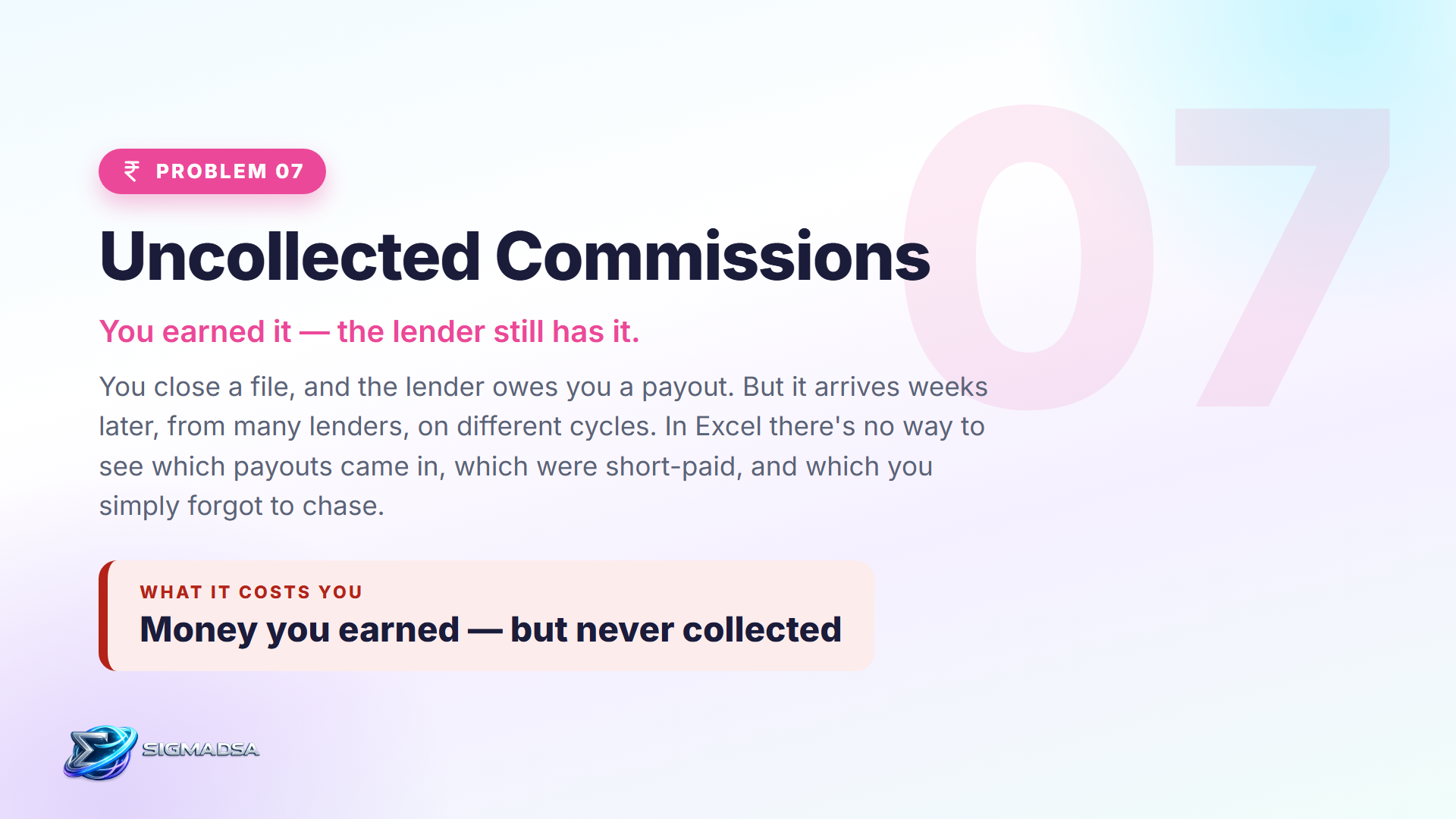
I won't give you a number. You should calculate your own.
It would be easy to put a figure on all this — "Excel is costing you ₹87,000 a month!" — and plenty of marketing does exactly that.
But you'd be right to distrust an invented number. So here's a more honest exercise.
Think back over last month. How many genuinely interested leads did you never follow up? Of those, assume just two would have closed. Multiply that by your average commission on a single deal — your number, not mine.
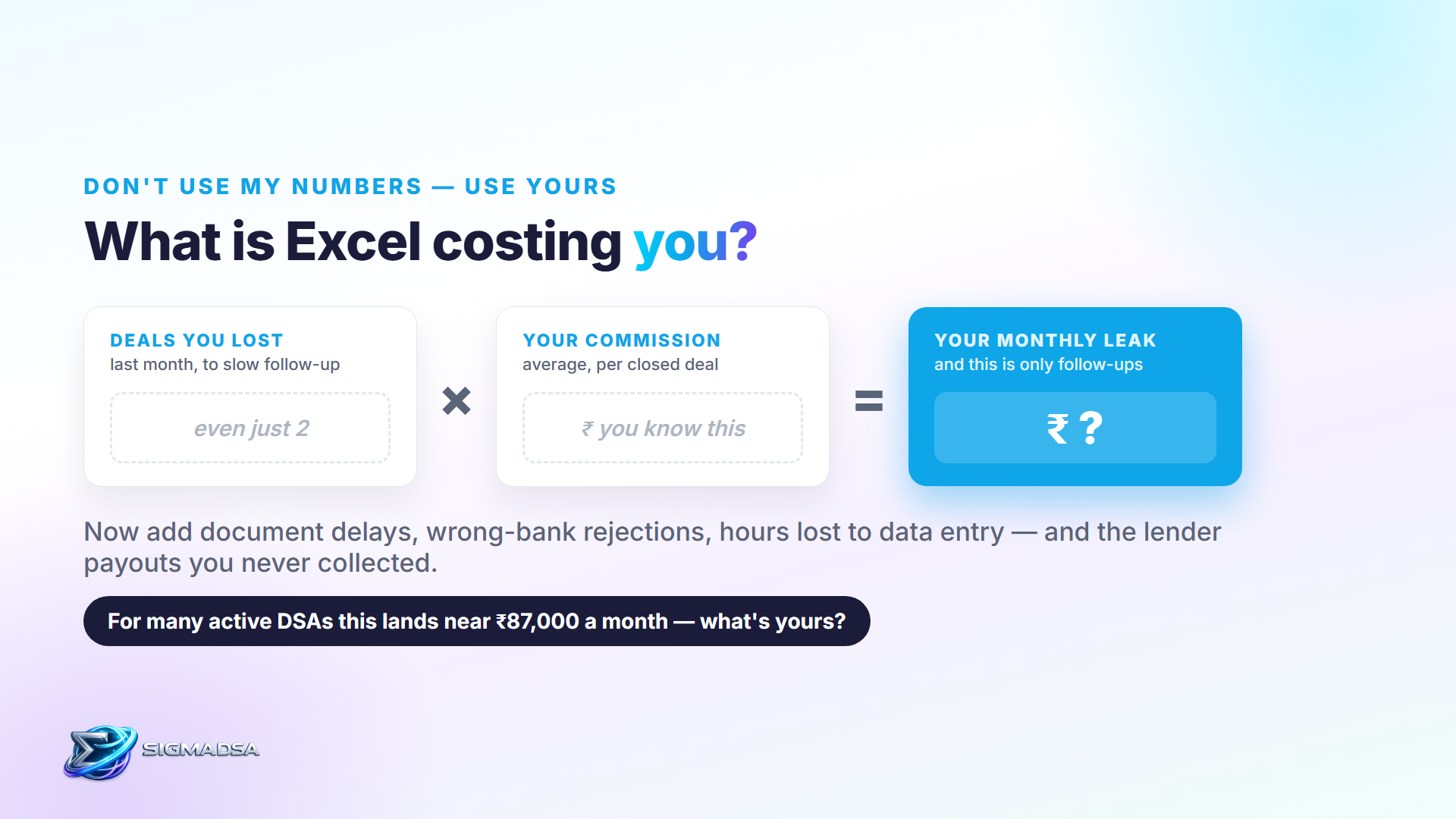
That's only the follow-up loss. Now add the files that missed a bank deadline, the deals rejected because of a wrong-bank recommendation, the hours lost to data entry and searching, and the commissions you never collected.
The figure you land on is your real cost of Excel. It doesn't arrive as an invoice. Nobody asks you to pay it. But you pay it — every month.
"So just get a CRM" — and why that hasn't worked
The obvious answer is a CRM. If it were that simple, you'd have done it years ago.
Many DSAs have, in fact, tried. Day one: full enthusiasm, everything set up. Within a week: back on Excel. There are three honest reasons why:
- A learning curve. New software, a new way of working, training for the whole team.
- A monthly cost. A CRM is never free — it's a recurring expense.
- The data-entry burden. Every lead, every detail, typed in by hand. The day you stop feeding it, the CRM becomes dead weight.
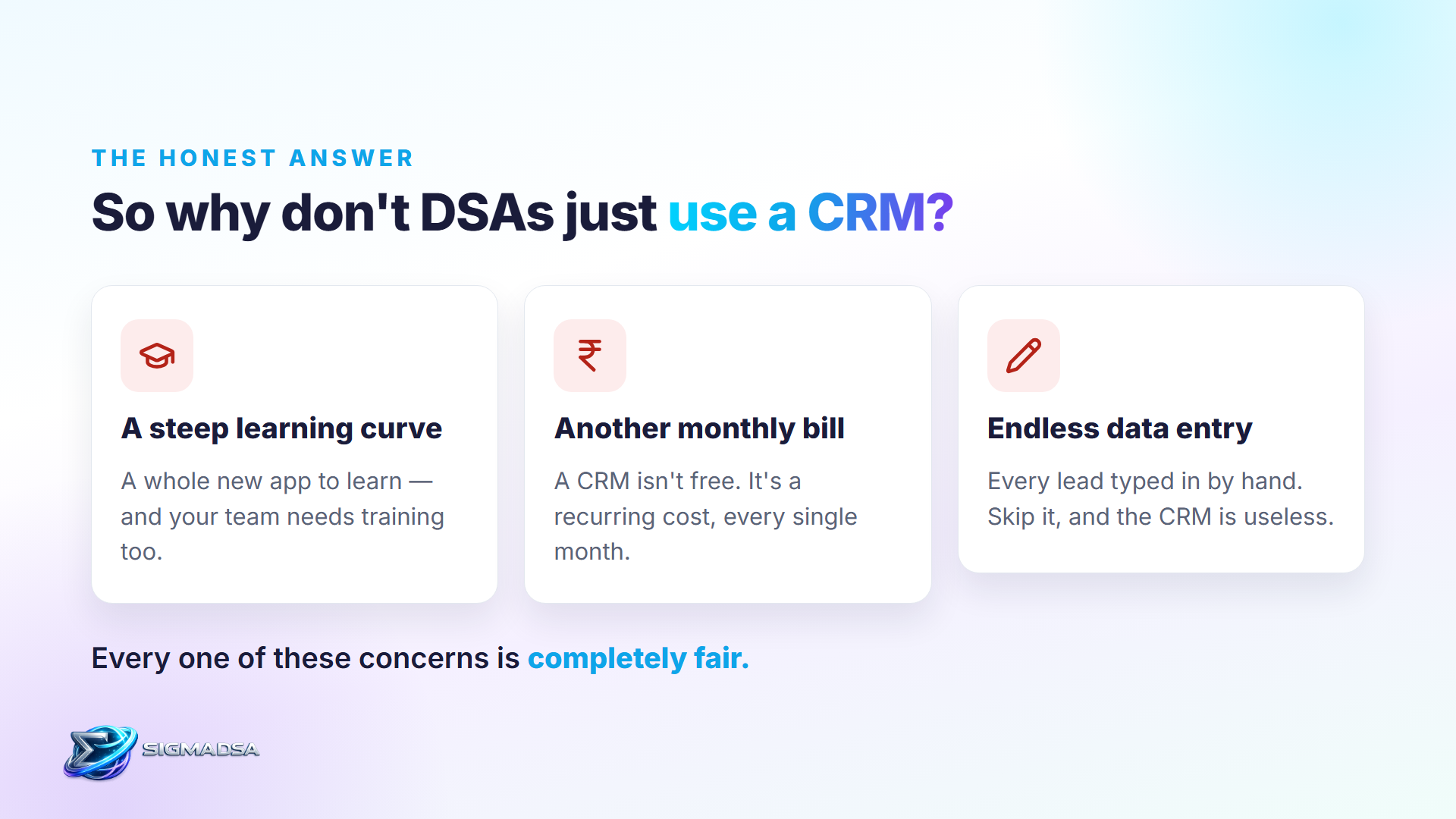
These objections are completely valid. A traditional CRM asks you to change how you work, and then do more work to keep it alive. That's why it gets abandoned.
So the answer isn't a better CRM. It's a different idea entirely.
Stop thinking "software." Start thinking "employee."
Imagine hiring someone for your desk who never takes a day off, never gets tired, works around the clock — and costs nothing close to a real salary.
That's the shift behind SigmaDSA. It isn't a CRM you log into and maintain. It's an AI Employee that works inside WhatsApp — the one app you, your team, and every borrower already use every day.
For your customers, it acts as a salesperson: it answers loan queries instantly, guides the borrower, captures the lead, and even tells them their file status — at any hour.
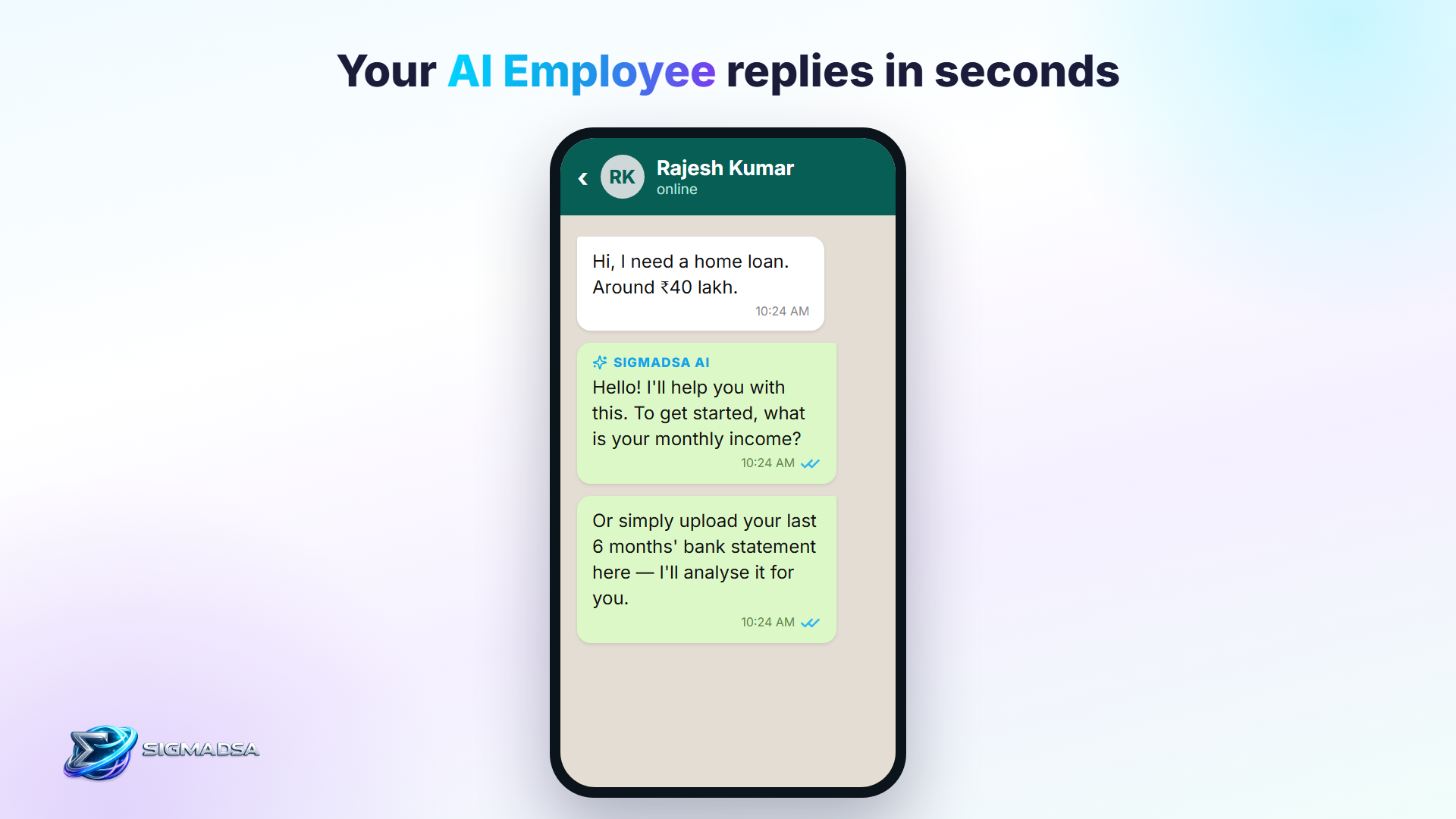
For you, it runs the entire pipeline by chat. Create a lead, manage follow-ups, convert a lead into a file, attach documents, add a sanction or a disbursal — all from a WhatsApp message, without opening a laptop or filling a single sheet.
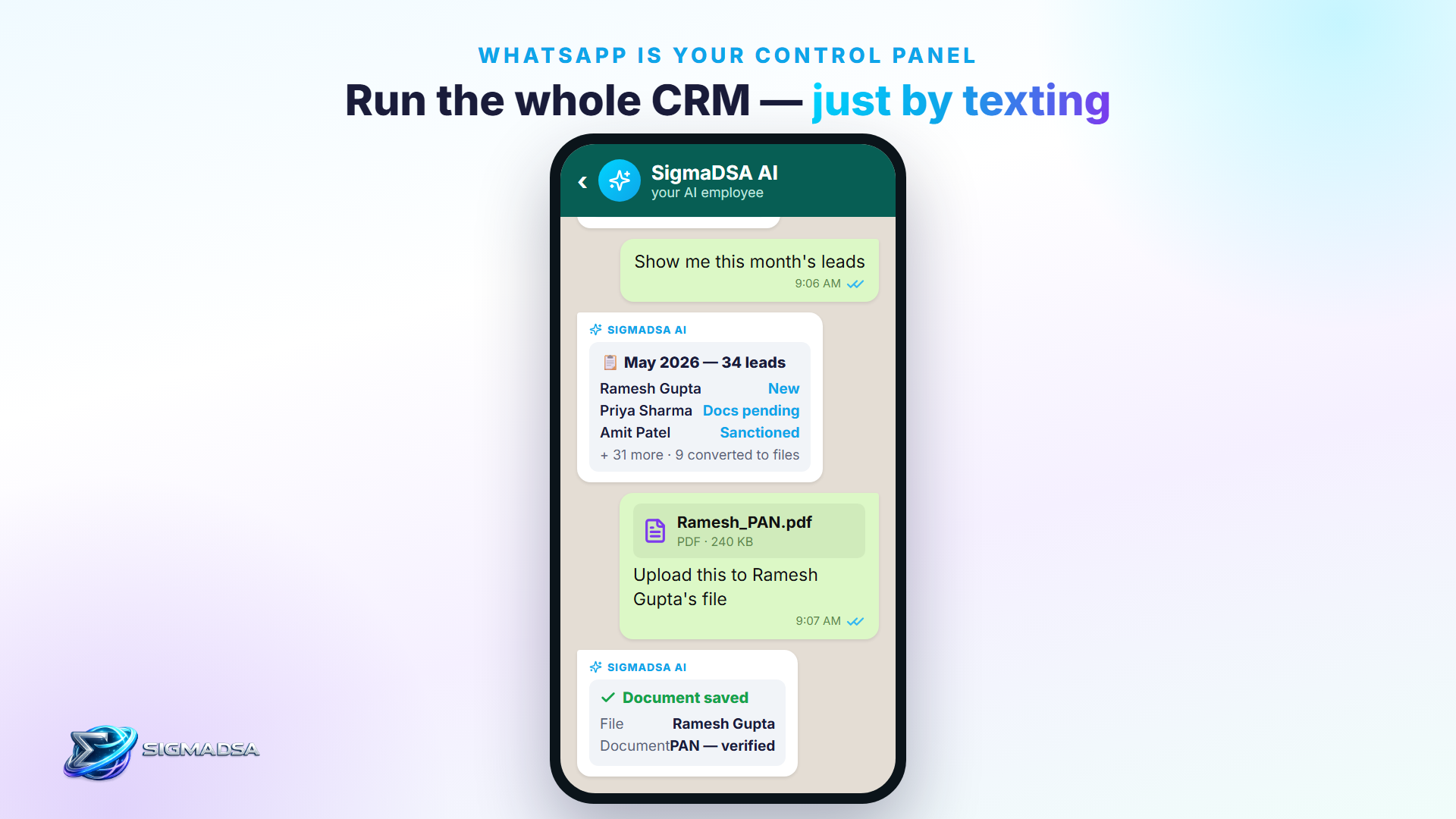
And it directly answers the three CRM objections:
- No new app to learn — it's just WhatsApp.
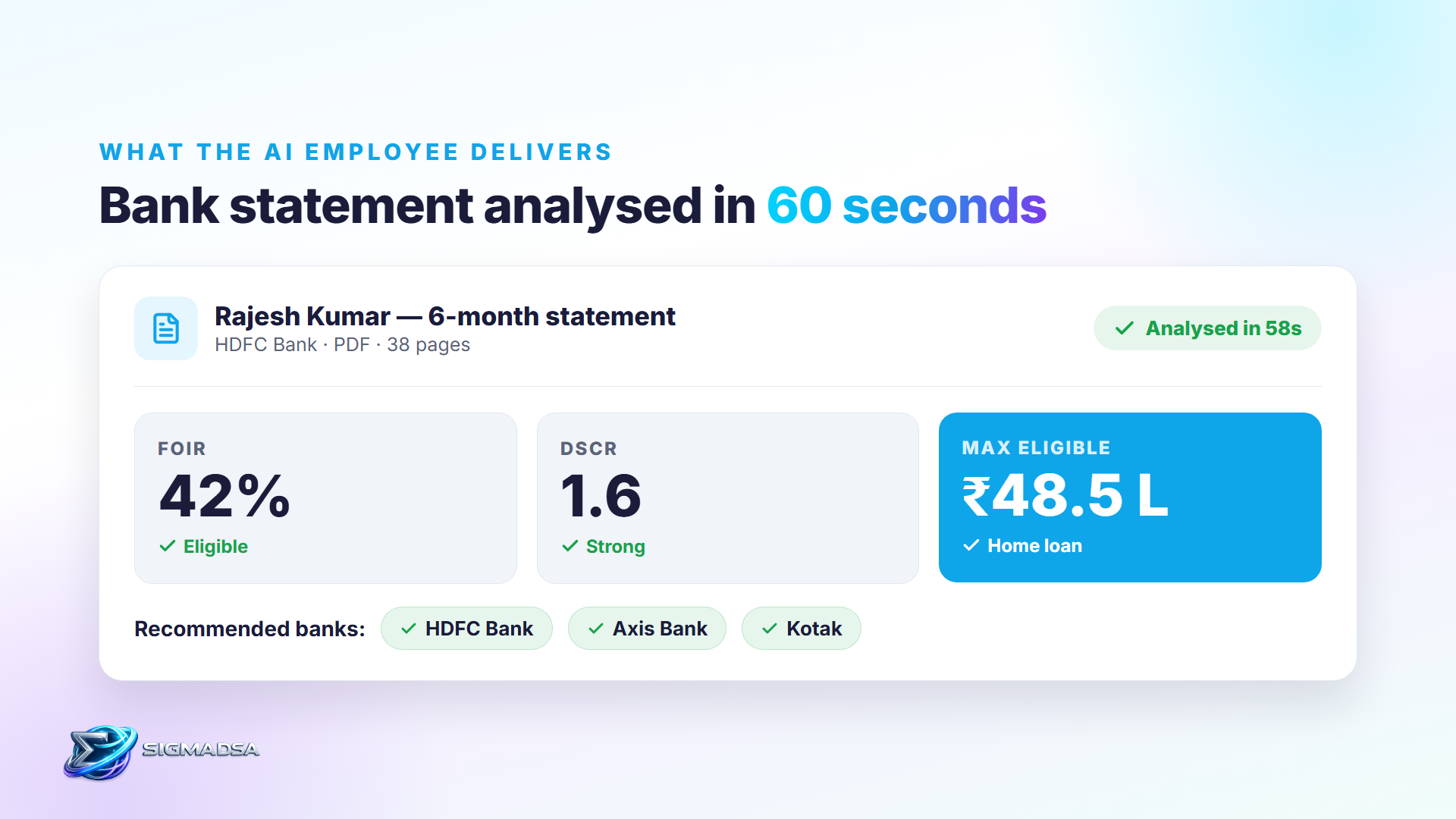
- No data entry — send a document and the AI reads it, pulling out name, PAN, income and more on its own. A forty-page bank statement is analysed — FOIR, DSCR, eligible lenders, loan amount — in about a minute, accurately.
- No training — if your team can send a message, they can use it.
A normal CRM gets abandoned because of all that effort. Remove the effort, and it doesn't get abandoned.
It also closes the loops Excel leaves open: it builds your daily to-do list and sends the follow-ups itself, so no warm lead is forgotten — and it tracks every file and every lender payout, so the commission you earned doesn't quietly go missing.
The real question
Excel will keep working. It will also keep costing you — the same leak, next month, and the month after, until something changes.
If you run a loan DSA business, do one small thing this week: actually calculate your own number. And then decide whether it's worth doing something about.
See how an AI Employee would run your desk
Built for loan DSAs — it works right inside WhatsApp.
Book a Demo